Understanding the Air Quality Index: A Simple Guide
Air quality can change from day to day depending on pollution levels, traffic activity, weather patterns, and environmental conditions. Because it is not always possible to see air pollution directly, environmental organizations use measurement systems to track and report air conditions. One of the most widely used tools for this purpose is the Air Quality Index, commonly known as AQI.
The Air Quality Index is designed to help people understand how clean or polluted the air may be in a particular location. By translating complex environmental data into simple numbers and color categories, the AQI allows individuals to quickly see whether current air conditions are considered good or potentially concerning.
Learning how the Air Quality Index works can help people stay aware of their environment and make informed decisions about daily activities. You may also find it helpful to read our article on how air quality affects your breathing health.
What the Air Quality Index Measures
The Air Quality Index measures the concentration of certain pollutants in the air. Environmental monitoring stations collect data about these pollutants and convert the information into a standardized AQI value.
Some of the most commonly monitored pollutants include:
- Particulate matter (PM2.5 and PM10) – tiny particles of dust, smoke, or pollution suspended in the air
- Ground-level ozone – a gas that forms when sunlight reacts with pollutants from vehicles and industrial emissions
- Nitrogen dioxide – a gas often produced by vehicle exhaust and power plants
- Sulfur dioxide – commonly associated with industrial processes and burning fuels
- Carbon monoxide – a gas produced by incomplete fuel combustion
By measuring the presence of these substances, the AQI provides an overall snapshot of the air conditions in a specific area.
How the AQI Scale Works
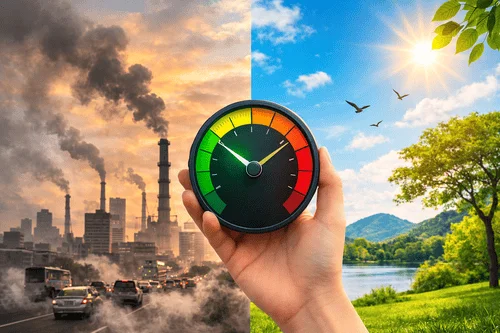
The Air Quality Index typically uses a numerical scale that ranges from 0 to 500. Lower numbers represent cleaner air, while higher numbers indicate increasing levels of pollution.
Many environmental conditions may influence breathing comfort. Our guide on environmental factors that affect lung comfort explains these influences in more detail.
- 0–50: Good – Air quality is considered clean and outdoor activities are generally comfortable.
- 51–100: Moderate – Air conditions are acceptable although some individuals may notice mild effects.
- 101–150: Unhealthy for Sensitive Groups – Sensitive individuals may prefer to limit prolonged outdoor exposure.
- 151–200: Unhealthy – Pollution levels are higher and some people may experience discomfort.
- 201–300: Very Unhealthy – Air conditions may affect a larger portion of the population.
- 301–500: Hazardous – Pollution levels are extremely high and warnings may be issued.
Why Air Quality Can Change Throughout the Day
Air quality is not always constant. Pollution levels can shift during the day due to human activity and environmental factors.
In many urban areas, pollution may increase during morning and evening traffic hours when large numbers of vehicles release exhaust into the air.
Ways to Stay Informed About Air Quality
Staying informed about air quality has become easier thanks to modern technology. Many weather services now include air quality updates alongside temperature forecasts.
- Checking local weather apps that provide AQI reports
- Visiting environmental agency websites that publish air quality updates
- Using smartphone notifications that alert users when pollution levels rise
To understand how indoor air conditions also influence breathing comfort, you may want to read indoor air pollution and lung wellness.
Conclusion
The Air Quality Index is a helpful tool that translates complex environmental measurements into a simple system that anyone can understand.
Learning how to interpret air quality reports can help individuals make better decisions about outdoor activities and environmental exposure.